
Overview
The PRO booking system allows for a highly customizable restaurant reservation process. It enables precise control over availability, quotas, booking durations, and seating arrangements. With this system, you can adapt your booking setup to match your restaurant’s operational needs.
This article explains how to configure the PRO booking system in Book mode, where guests can reserve tables based on real-time availability.
Before getting started
Before enabling the PRO booking system, make sure you:
- Have access to Content > Facilities > Restaurants in the CMS.
- Have a restaurant created in the system.
- Have defined the restaurant’s timetables and availability.
- Understand how many tables or seating areas need to be managed.
Step-by-step guide
Step 1: Request activation from Support
Before you can configure the PRO booking system, you need to request its activation. Please contact our Support team through any of these channels:
- Live chat via the CMS.
- Support ticket
Once activated, you can proceed with the next steps in this guide.
Step 2: Enable the PRO booking system
- Go to Content > Facilities > Restaurants in the CMS.
- Select the restaurant you want to configure.
- Click Edit.
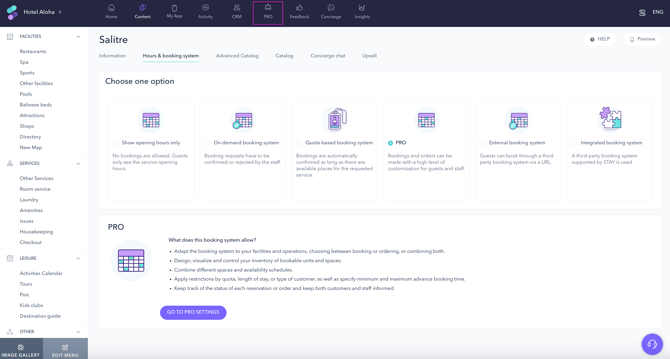
- Navigate to the Hours & booking system tab.
- Select PRO.
- Click Save changes.
Step 3: Access PRO settings
- After enabling PRO, a button labeled Go to PRO settings will be enabled at the bottom of the screen.
- Click Go to PRO settings to access the configuration options.
- Alternatively, you can access PRO settings by navigating to PRO (top menu in the CMS), selecting the relevant service, and clicking the settings icon (first icon from the right).
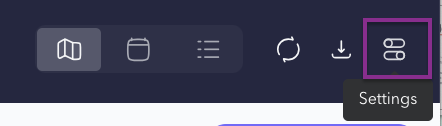
Note: In the PRO system, there are two different screens:
- The reservations screen (which appears when you first enter PRO).
- The settings screen (accessible by clicking the settings icon in PRO).
Step 4: Select the setting mode
Since this article focuses on Book mode, follow these steps:
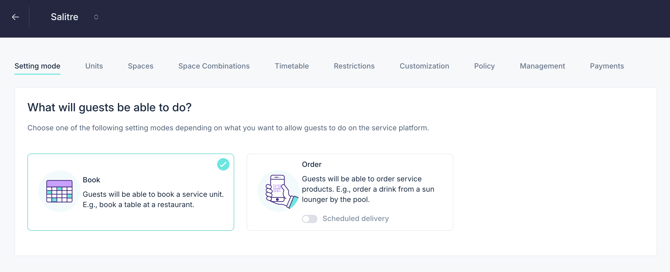
- In PRO Settings, go to the Setting mode section.
- Select Book.
- Click Save changes.
Step 5: Create bookable units (tables)
Before setting up availability, you need to define the units guests will book (e.g., tables, seating areas).
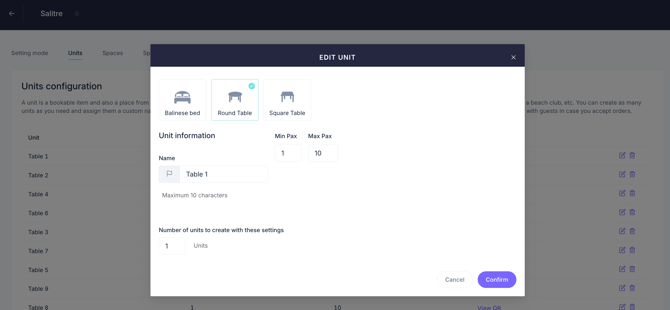
- Go to PRO > Your restaurant > Settings > Units.
- Click Add unit.
- Assign a unit type (round table, square table).
- Enter a name (e.g., "Table 1") (10 characters maximum) and click on the flag icon if you need to add translations to other languages.
- Set the minimum and maximum number of people per unit in the Min Pax and Max Pax boxes.
- Type in the number of units you want to create with these same settings.
- Click Confirm.
If you want to create more units with other settings, click Add unit again and follow the same steps.
Once created, they will be listed in this section and you can edit or delete them by clicking on the icons on the right.
Step 6: Define spaces
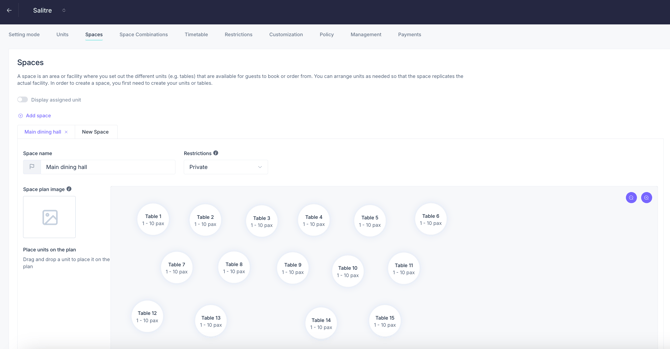
Spaces allow you to group units (tables) by location or category. You can arrange units as needed so that the space resembles the actual facility.
At the top of the screen, you see the option Display assigned unit. Enable this if you want customers to see which specific unit (table) has been assigned to their reservation. If you prefer to keep this information hidden, leave the toggle off.
In order to create a space, you should have already created your units (Step 4).
-
Go to Settings > Spaces.
-
Click Add space.
-
Enter a name (e.g., "Main dining area"). Note that it will be visible to the customer.
- In the Restrictions field, define whether the space is private or shared.
- Private: Each reservation will have exclusive use of a unit during the reserved time slot. This is the standard setup for most restaurants.
- Shared: A unit (table) can be assigned to multiple reservations at the same time. This is useful in contexts like a teppanyaki or communal dining restaurant, where guests share large tables.
-
Add an image of the space plan.
-
Drag the units to the floor plan on the right and arrange them as you wish.
-
Click Save.
-
Optional: Use the Add unit combination button to configure how the system handles bookings that exceed a single unit’s capacity. Select which units should be grouped to accommodate larger reservations.
For example, if each unit holds 4 people and a guest books for 10, you can set the system to combine 3 units. Define the minimum and maximum number of guests for these combinations and save the changes.
If you want to edit a unit from the floor plan, click on it and 2 options will appear: Edit and Delete.
Step 7: Define space combinations
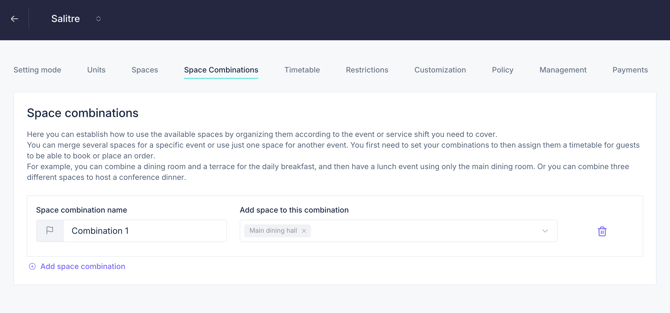
Use space combinations to organize available spaces based on different events or service shifts. You can merge multiple spaces for a specific event or use individual spaces as needed.
For example, you might combine a dining room and a terrace for breakfast service but only use the main dining room for lunch. Or, for a large event like a conference dinner, you can merge three different spaces.
To create a space combination:
- Go to Settings > Space combinations.
- Click Add space combination.
- Enter a name for the combination.
- Select the spaces to be merged.
- Click Save.
Create as many combinations as needed to match your property's different shifts or events.
Step 8: Set bookable hours
Define and assign an availability timetable to the space combinations you created. This schedule determines when guests can make reservations.
To create a timetable:
-
Go to Settings > Timetable.
-
Click Add schedule.
-
Select the days of the week this schedule will apply to.
-
Define intervals (name, start time, and end time) and assign them to a space combination. Intervals are time slots that occur throughout the day, each with a defined start and end time. For example: breakfast, lunch, or dinner.
-
To allow bookings, turn on Bookable. You can also activate Disable app bookings if you want to manage reservations internally without guest access.
-
Configure additional settings:
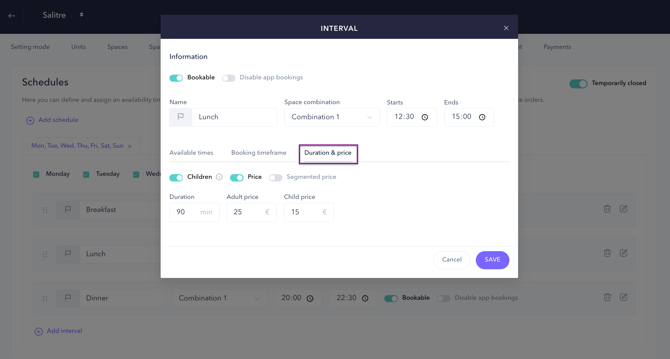
To customize each interval further, click the Edit icon. A pop-up window will open with three tabs.
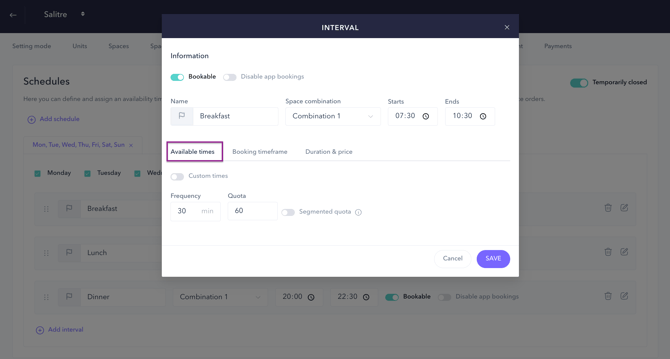
- Available times
- Custom times: Set specific quotas per time and apply customer segmentation.
- Frequency: Define how often booking slots are available (e.g., every 30 minutes).
- Quota: Specify the number of available seats based on frequency.
- Segmented quota: Assign a specific quota per customer segment. This requires predefined segmentation (CMS home > Settings icon > Hotel > Segmentation).
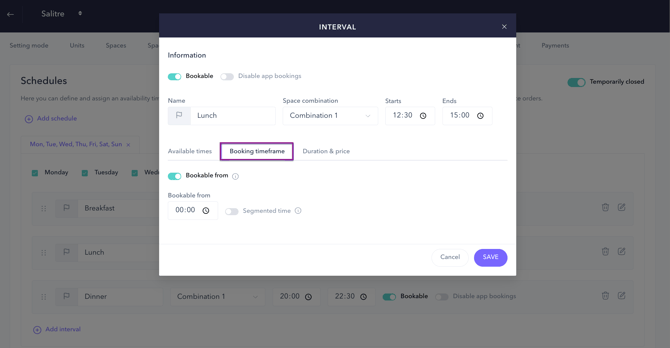
- Booking timeframe
- Bookable from: Set the time from which the service can be booked.
- Book times past due: Allows reservations to be made during the ongoing time slot, overriding the minimum advance time restriction. This option is only available with custom times.
- Segmented time: Set a specific time per customer segment (requires segmentation setup).
- Duration & price
- Children: Enable this option to allow the selection of children separately from adults in the booking process. You can define the child age range in the Customization tab.
- Price: Enable pricing to display the cost of the service to guests.
- Segmented price: Assign specific prices per customer segment.
- Duration: Set how long each booking lasts.
-
If you need to add more intervals to the same schedule, click Add interval and follow the same steps.
-
If you need different schedules for specific days (e.g., weekends), click Add schedule. Each schedule will be displayed as a separate tab.
-
If you need the service to be shown as unavailable for some time, activate the Temporarily closed switch. This prevents any new bookings until the switch is turned off.
-
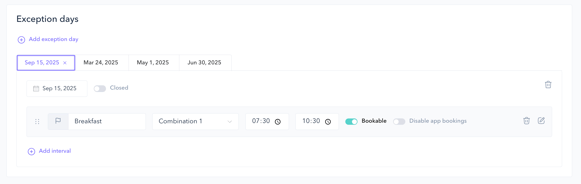
Configure exception days:
You can override the regular schedule by setting exception days. This is useful when the restaurant hosts a private event or needs to close for maintenance.
- Click Add exception day.
- Select a date from the calendar.
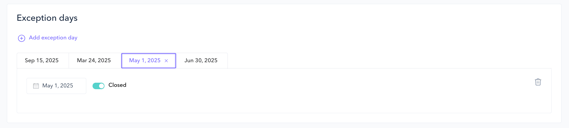
- Choose one of the following:
- Activate the Closed switch to mark the service as unavailable all day.
- Define specific intervals for that day (name, space combination, start and end time, etc.). Click the Edit icon to configure advanced settings.
- Activate the Bookable switch if reservations should be allowed during the interval.
- Optional: Add more intervals for the same day.
- To create additional exception days, click Add exception day. Each exception day will be displayed as a separate tab.
- Click Save changes to apply the settings.
- If opening hours differ from bookable hours, you can enable the toggle button for Opening hours different from bookable hours and set the specific opening hours in this section. They will be visible to customers for informational purposes only. If this option is not enabled, the bookable hours set above will be displayed instead.
- Available times
Step 9: Set booking restrictions
You can set restrictions to control how and when guests can book the service. To do so, go to Settings > Restrictions.
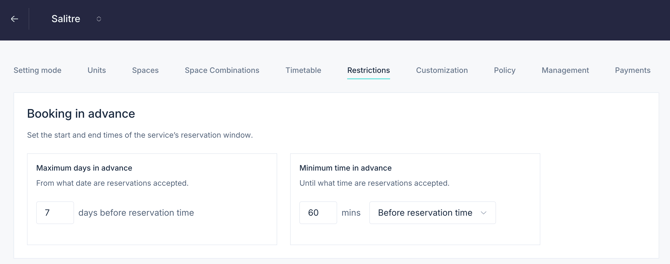
Booking in advance
Define the start and end times of the service reservation window:
- Maximum days in advance: How far in advance guests can book. Set in days based on the reservation time.
- Minimum time in advance: The shortest notice required to make a reservation. Set in minutes and can be referenced from:
- The opening time of the service.
- The time the guest wants to book (reservation time).
Restrictions per day
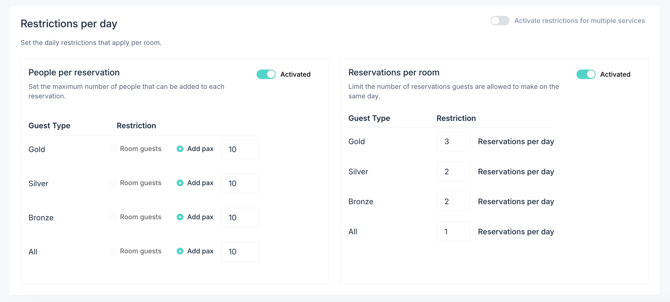
You can limit the number of reservations per day with two options:
- People per reservation: Set a limit based on the number of guests in the room or a specific number of people.
- Reservations per room: Define the daily booking limit per room.
Important: The value related to the number of guests per room can be used if your PMS is integrated with STAY and sending this data. Otherwise, this restriction cannot be applied.
Turn on the Activated switch next to each option to apply the restriction.
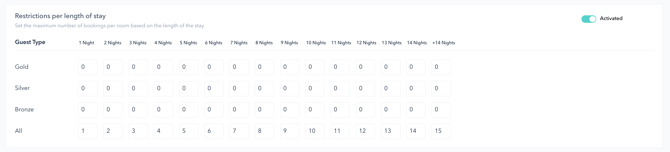
Restrictions per length of stay
Set the number of bookings per room depending on the guest’s length of stay. Enter the limit for each duration in the corresponding field. Turn on the Activated switch to apply the restriction.
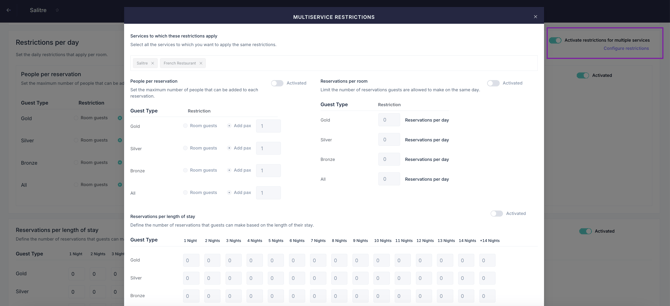
Apply restrictions to multiple services:
If you need to use the same restrictions across multiple services, enable Activate restrictions for multiple services (top right side of the section). This ensures you only need to configure restrictions once.
Note: This option is applicable to Restrictions per day and Restrictions per length of stay only.
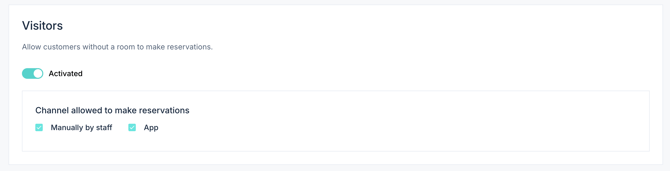
Bookings from visitors
Decide whether non-staying customers can book the service.
If enabled, choose the supported channel: manual (staff-only) or app (guest self-booking). Turn on the Activated switch to apply the restriction.
External bookings
Allow bookings from guests staying at associated or nearby properties. This option must be activated by the STAY team—contact support for setup.
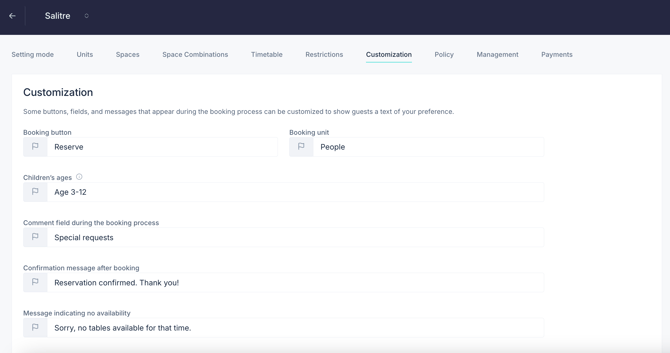
Step 10: Customize booking messages
You can personalize the messages guests receive at different stages of the booking process.
Go to Settings > Customization.
The following elements can be customized:
- Booking button – Modify the text displayed on the booking action button.
- Booking unit – Define how the booking unit is labeled (e.g., "Pax").
- Children’s ages – Indicate what age range is considered a child (e.g., “Children aged 3–12”).
- Comment field – Adjust the prompt shown above the comment field during booking.
- Booking confirmation message – Customize the message guests see after completing a reservation.
- No availability message – Set a custom message displayed when no booking times are available.
If no custom text is defined, the system will display the default option.
Step 11: Set a booking policy
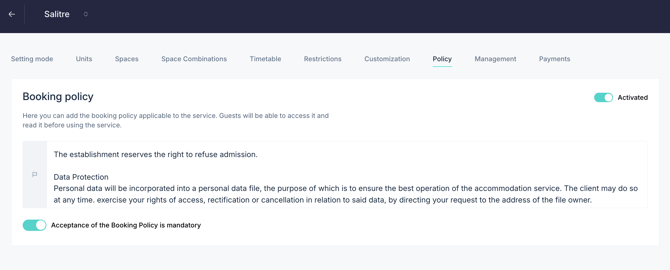
You can define a booking policy that guests must review before completing a reservation.
How to add a booking policy:
- Go to Settings > Policy.
- Type or paste the booking policy into the text box.
- Toggle the Activated switch to make it visible to guests.
- Optional: If you require guests to acknowledge and accept the policy before booking, enable Acceptance of the booking policy is mandatory.
- Click Save changes.
Step 12: Manage staff access and reservation reminders
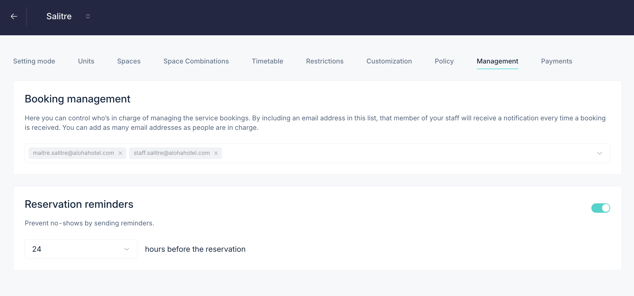
In the Management tab, you can grant staff access to manage bookings and configure automatic reservation reminders for guests.
How to add staff members:
- Go to Settings > Management.
- Enter the email addresses of the team members responsible for managing reservations.
- Each staff member added will receive notifications when a new booking is made.
- Click Save changes.
How to enable reservation reminders:
- Go to Settings > Management.
- Locate the Reservation reminders option.
- Enable the toggle to activate reminders.
- Select when the reminder should be sent:
- 24 hours before the reservation, or
- 48 hours before the reservation.
- Click Save changes.
Step 13: Configure payment options
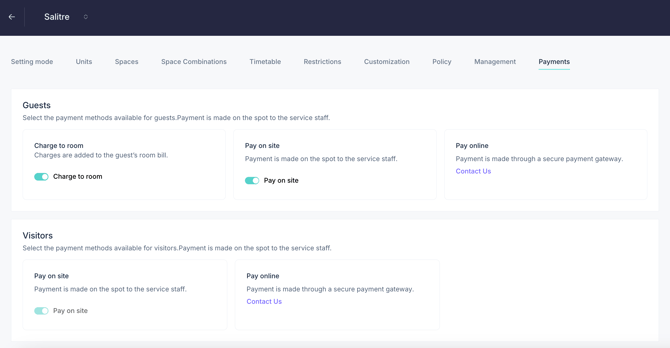
You can choose which payment methods are available for customers.
Available payment options for guests:
- Charge to room – The booking amount is added to the guest’s room bill.
- Pay on site – Guests pay on the spot to the service staff.
- Pay online – Guests pay through a secure payment gateway. Learn more here.
Available payment options for visitors:
- Pay on site – Visitors pay on the spot to the service staff.
- Pay online – Visitors pay through a secure payment gateway. Learn more here.
Important: When a reservation has already been paid and you need to modify it, you will only be able to update the Unit and Notes fields. Any other changes—such as adjusting the time—are blocked, as they may affect the final price of the service.
STAY does not offer automatic refunds for paid reservations. If a paid reservation is canceled, the hotel is responsible for managing the refund directly through its payment provider (Stripe or Adyen).
Step 14: Enable and test the booking system
Once all settings are configured:
- Enable the booking system by toggling the Enable bookings switch in the Timetable section for the relevant intervals.
- Click Save changes.
- Use the Preview option in the CMS home to test the booking process as a guest.
Next steps
Now that your restaurant’s PRO booking system is set up:
- Make your restaurant visible on the app front page to start receiving bookings.
- Monitor reservations in the PRO > Reservations (Floor plan / Calendar / List view) screen.
- Train staff on managing bookings through the CMS.
Need further assistance?
If you have additional questions or require further assistance:
- Contact us via live chat.
- Send a ticket to our Support team.
- Visit STAY Academy, our training platform.